


Accounting Services for Online Businesses to Simplify Financial Management
Hire Remote Bookkeeper, Accountant, Tax Preparer, or Admin Staff
Monthly Bookkeeping, Payroll, Financial Reports, and Tax Help for Online Businesses to Simplify Financial Management
Bookkeeping For Online Businesses?
Bookkeeping and accounting are critical aspects of managing the financial side of any business, including online/e-commerce ventures in Australia. Let’s understand the necessity of bookkeeping and accounting for ecommerce businesses in Australia:
Bookkeeping: Bookkeeping involves the systematic recording and organization of day-to-day financial transactions. It includes tasks such as tracking sales, purchases, expenses, and payments. Bookkeepers ensure that all financial data is accurately recorded in ledgers or software systems.
Bookkeeping for Online/E-commerce Businesses in Australia:
- Set up a proper bookkeeping system using accounting software tailored for e-commerce businesses or hire a qualified bookkeeper with expertise in online selling platforms.
- Track and record all business-related expenses, including inventory costs, shipping fees, advertising expenses, website maintenance fees, and incoming revenue from sales.
- Ensure compliance with record-keeping requirements mandated by the Australian Taxation Office (ATO), which typically requires keeping records for at least five years from when they were prepared or obtained.
Accounting for Online/E-commerce Businesses in Australia:
- Obtain a clear understanding of basic accounting principles or seek professional advice from an accountant experienced in e-commerce taxation laws to ensure compliance with reporting obligations.
- Generate financial reports tailored to the specific needs of online businesses, including Goods and Services Tax (GST) reporting, Business Activity Statements (BAS), and income tax returns.
- Utilize accounting insights to make strategic decisions that can positively impact the growth and profitability of the online/e-commerce business.
How to get started with bookkeeping and accounting
for online/e-commerce businesses in Australia?
Reliable Computer and Internet Access
Choose the Right Software
Separate Business Accounts

Track Incoming and Outgoing Payments
Accurate Record-Keeping
Seek Professional Advice
How does Meru Accounting help e-commerce
businesses with Accounting and Bookkeeping?
Are you looking for a bookkeeper for Ecommerce Business? Meru Accounting has vast experience when it comes to maintaining accounts for leading online companies and start-ups. We use software like the Shopping cart to help you create a platform for your online business and carry out further business operations. With these kinds of software, we provide exceptional Ecommerce Accounting services. We handle your sales, bank transactions, paid and unpaid orders, and even customers.
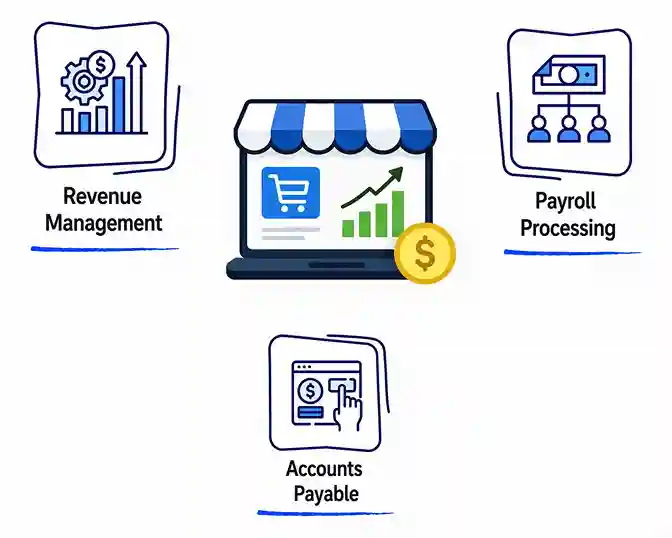
As an e-commerce seller, you may be dealing with multiple tasks. Let us ease your burden with our expert Ecommerce seller accounting services. We specialize in managing your revenue streams, expenses, and tax compliance, allowing you to focus on what you do best – growing your online business.
Online businesses are involved in huge traffic and online transactions, as there is no fixed time for a customer’s visit. Therefore, we use software that ensures a high level of security of your online transactions which is also helpful while importing the data to your accounting software. We, at Meru Accounting, manage accounting payables and receivables with the help of various add-ons. These add-ons help us track and receive & pay the due amount. So, you need not worry about getting into the cash-flow trap. With our Ecommerce Seller Accounting, we help you switch from your regular traditional accounting software to some of the leading software like Xero and Quickbooks and ensure that all your data is synced properly.
Contact us now and transform your online business in Australia with our Ecommerce Bookkeeping services.
Record-keeping requirements for
online/e-commerce businesses in Australia
01. Sales Transactions
- Maintain accurate records of all sales transactions.
- Include details such as the date of sale, customer information, product or service description, and the amount received.
- These records help track revenue over time and reconcile sales figures.
02. Expense Tracking
- Keep detailed records of business expenses, including sourcing products, packaging materials, shipping fees, marketing expenses, website maintenance fees, etc.
- Accurate expense records help calculate profit margins and identify cost-saving opportunities.
03. Invoices and Receipts
- Retain copies of all invoices and receipts for purchases made by the business.
- These documents serve as evidence for claiming input tax credits (if registered for GST) or deducting business expenses from taxable income.
04. GST Records (if applicable)
- If your business is registered for Goods and Services Tax (GST), maintain records related to GST payments and receipts.
- Keep track of GST collected on sales and GST paid on expenses.
05. Employee Records (if applicable)
- If you have employees, maintain records of their employment details, including contracts, wages, and superannuation contributions.
06. Financial Statements
- Prepare and retain financial statements, including balance sheets, income statements, and cash flow statements.
- These statements provide an overall view of a business’s financial condition.
07. Banking Records
- Keep records of all bank statements, including deposits, withdrawals, and other financial transactions.
- Bank records help reconcile financial data and ensure accuracy.
08. Asset and Inventory Records
- Maintain records of business assets and inventory, including their acquisition, depreciation, and sales.
- These records are essential for assessing the value of assets and managing inventory levels.
09. Taxation Records
- Retain all tax-related records, including income tax returns, BAS statements, and any correspondence with the Australian Taxation Office (ATO).
10. Electronic Copies and Backups
- Ensure all records, whether physical or electronic are securely stored and easily accessible.
- Implement backup systems to safeguard financial data and prevent data loss.
Financial reporting requirements for
online/e-commerce businesses in Australia
Financial Statements
Arrange the financial statements, including an income statement, balance sheet, and cash flow statement. These statements provide a snapshot of the business’s financial position and performance over a specific period.
Goods and Services Tax (GST) Reporting
If your annual turnover exceeds $75,000 (or $150,000 for non-profit organizations), register for GST with the ATO. Submit regular Business Activity Statements (BAS) to report GST information.
Customs Duties and International Tax Reporting
If your business sells products internationally or imports goods into Australia, comply with reporting obligations related to customs duties and international tax laws.
Detailed Transaction and Expense Records
Maintain comprehensive records of all transactions, including invoices, receipts, bank statements, sales data, and shipping costs. Accuracy in maintaining records ensures transparency and allows smooth financial reporting.
Outsourcing Bookkeeping Tasks
Consider outsourcing bookkeeping tasks to ensure accuracy in financial reporting and reduce the risk of errors or omissions. Professional bookkeepers can help maintain compliance and keep financial records up-to-date.
Inventory Reporting (if applicable)
If your business involves selling physical products, maintain records of inventory levels and value for accurate financial reporting.
Employee Reporting (if applicable)
If you have employees, comply with reporting obligations related to payroll, superannuation contributions, and employee taxes.
Record Retention
Be aware of the required record retention periods for financial and tax-related documents as per Australian laws.
Timely Submission
Ensure timely submission of financial reports, BAS, and other required documents to the relevant authorities.
Seek Professional Advice
If you are unsure about any financial reporting requirements, seek advice from a qualified accountant or financial advisor. Professional guidance will help you understand and comply with all relevant regulations.
Conclusion
In conclusion, for online and e-commerce businesses in Australia, efficient bookkeeping and accounting are essential for staying organized, compliant, and financially successful. Understanding the basics of bookkeeping and accounting involves choosing the right software or outsourcing partner, setting up a chart of accounts, diligently tracking expenses and income, keeping accurate records, and meeting financial reporting requirements. Meru Accounting, a cloud-based accounting solution, can be a game-changer for such businesses. Its user-friendly platform simplifies financial management, enabling businesses to categorize transactions accurately and track revenue, expenses, and taxes effectively.
With Meru Accounting, businesses can maintain accurate records, generate essential financial statements, and stay compliant with Goods and Services Tax (GST) reporting requirements. Whether managing bookkeeping internally or collaborating with outsourced professionals, Meru Accounting offers the necessary tools and capabilities to optimize financial processes and pave the way for growth opportunities. The platform’s data security and accessibility ensure peace of mind, allowing businesses to focus on strategic decision-making and overall financial health.